Back to School Smart Notes Planner Pages
If you have ever stood in the school supply aisle holding a paper planner in one hand and your phone in the other, wondering why the two cannot just get along, you are not alone. The Back to School Smart Notes Planner Pages bridge that gap in a way that finally makes sense. These are not your average notebook pages. They are dot grid sheets with QR codes that the Rocketbook app reads instantly, letting you scan handwritten notes and send them to Google Drive, OneNote, Evernote, Dropbox, OneDrive, Trello, Slack, Box, Google Photos, or NextCloud. You can also email them to yourself or someone else. The pages measure 8.5 by 11 inches, include a class schedule and a grade tracker that works with both letter and percentage grading systems, and they feel like paper but behave like a digital file. That combination changes how you organize your semester.
What These Pages Actually Look Like and How They Feel
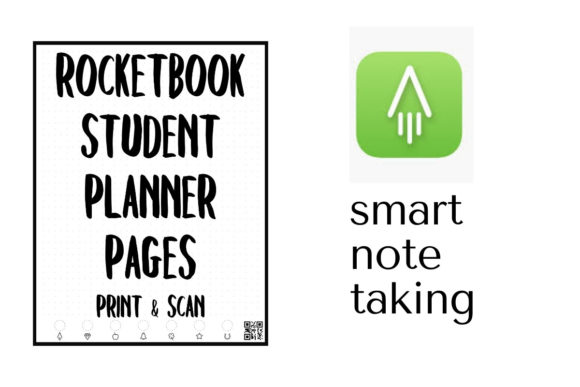
The visual personality of the Back to School Smart Notes Planner Pages is purposeful and clean. The dot grid gives you a structured canvas without the heaviness of ruled lines. You can write in straight lines, sketch diagrams, draw charts for grade tracking, or map out project timelines without feeling boxed in. The QR codes sit discreetly on each page, and the app reads them in a split second. The grade tracker page is laid out for both letter grades and percentages, so you do not have to mentally convert between systems. The class schedule page has generous space for course names, room numbers, and time blocks. Everything about the layout prioritizes function over decoration, but it does not look sterile. The subtle dot pattern adds a quiet rhythm to the page, and the overall impression is one of intentional design. It is a system that respects your time and your need for clarity.
Where This Planner System Works Best
Students are the obvious audience, but the Back to School Smart Notes Planner Pages extend far beyond campus. Designers who sketch concepts during client meetings can scan those sketches directly into project folders. Entrepreneurs juggling multiple ventures can use the grade tracker as a performance dashboard for different initiatives. Marketers who map out campaign timelines on paper can send those pages to Trello or Slack with one scan. Bloggers and content creators who brainstorm post ideas in a notebook can upload them to Google Drive and never lose a scrap of inspiration. Small business owners who track inventory, goals, or employee schedules on paper can digitize everything without typing a word. The hybrid nature of these pages means you get the cognitive benefits of writing by hand and the organizational power of cloud storage. That is hard to beat.
How the Pages Influence Readability and Workflow
Readability in this context is not just about legible handwriting. It is about how quickly you can find and use your information. The dot grid provides subtle alignment guides that make your writing naturally neat. When you scan a page using the Rocketbook app, the app crops and straightens the image automatically, so your notes look clean on screen. The QR codes at the bottom tell the app where to send each page, so you do not waste time sorting files manually. The grade tracker is designed so you can see your progress across multiple classes at a glance. That visual hierarchy is embedded in the page layout, not something you have to build yourself. For a busy professional or a stressed student, that kind of built-in organization is a relief. It reduces friction between the moment you write something and the moment you use it.
From a brand perception standpoint, using a system like this signals competence. When you share a scanned page from a meeting or a class, the output is crisp, well-framed, and professional. There is no glare from a spiral binding, no torn edges, no coffee stains. The page becomes a document that looks deliberate. That consistency matters whether you are collaborating with a team, submitting an assignment, or sharing notes with a colleague. The Back to School Smart Notes Planner Pages make you look organized, and that perception carries weight in professional and academic settings alike.
Practical Guidance for Choosing and Using This System
Before you commit to a full semester of use, consider how you actually work. Do you prefer letter grades or percentages? The grade tracker handles both, so you do not need to choose. Do you use multiple cloud services? The Rocketbook app sends pages to Google Drive, OneNote, Evernote, Dropbox, OneDrive, Trello, Slack, Box, Google Photos, and NextCloud. You can also email pages directly. That flexibility means you can integrate these pages into almost any existing workflow. If you are a heavy user of Notion or a different platform, you can still scan to email or a cloud drive and then import from there.
One practical tip: set up your destination folders and scan destinations in the app before you start writing. The QR codes at the bottom of each page can be assigned to different destinations. For example, you might send class notes to OneNote, meeting sketches to Trello, and personal to-do lists to your email. Once you set those assignments, the app remembers them. That initial setup takes ten minutes and saves you hours of sorting later. Another recommendation is to use a pen that writes smoothly on the paper. The dot grid is designed for clean writing, but a scratchy pen will still feel unpleasant. A fine-tip gel pen or a fountain pen with a medium nib works beautifully on these sheets.
Realistic Examples of This System in Action
A marketing manager at a mid-size agency uses the Back to School Smart Notes Planner Pages to plan quarterly campaigns. She sketches the campaign funnel on a dot grid page, writes key dates and budget allocations, and scans the page directly to Trello. Her creative team sees the update within seconds. A freelance graphic designer uses the grade tracker to track client satisfaction scores across five ongoing projects. Each client gets a row, and he updates their percentage score weekly. The visualization helps him spot which accounts need extra attention before they become problems. A college student taking four courses uses the class schedule page to block out lecture times, lab sessions, and study hours. At the end of each week, he scans his notes to OneDrive and shares the folder with his study group. Everyone stays on the same page without extra email chains.
What makes these examples work is the low barrier between thought and action. You write, you scan, you share. No typing, no formatting, no manual file naming. The Back to School Smart Notes Planner Pages remove the administrative overhead that usually comes with going digital. That is the real value. It is not about fancy typography or decorative layouts. It is about a system that fits the way you actually think and work.
Design Observations and Practical Recommendations
The dot grid is the defining visual element here. It gives you the freedom to write, draw, chart, and map without constraints, but it also provides enough structure to keep your work organized. If you have ever tried to draw a graph on ruled paper or write neatly on a blank sheet, you understand why the dot grid is a smart middle ground. The QR codes are small and unobtrusive, so they do not distract from your content. The overall look is modern and minimal without feeling cold. It is the kind of design that disappears when you are working and reappears when you need to scan or share.
For anyone considering these pages, think about your long-term workflow. If you already use cloud storage heavily, this system will feel natural from day one. If you are newer to digital organization, the learning curve is shallow because the paper side is so familiar. Start with one or two pages for a single class or project. See how the scanning and sharing process feels. Adjust your destination assignments as you go. The system rewards a little upfront configuration with a lot of ongoing efficiency.
The Back to School Smart Notes Planner Pages are not trying to replace your laptop or your favorite app. They are trying to make your handwriting as useful as your typing. For designers, entrepreneurs, marketers, bloggers, publishers, content creators, crafters, hobbyists, and small business owners who still think best with a pen in hand, that is a significant upgrade.