Number Missing Numbers Back to School: A Strategic Tool for Foundational Math Skills
When preparing young learners for the school year, the materials you choose can significantly influence how children approach numbers, patterns, and problem-solving. Number Missing Numbers Back to School is a focused printable resource designed for pre-kindergarten, kindergarten, and first-grade students. It provides ten pages of missing-number exercises covering numbers 1 through 20, delivered as a PDF file. While this may appear to be a simple worksheet set, its strategic value lies in how it supports early mathematical reasoning, attention to sequence, and confidence in number recognition.
For educators, homeschool parents, and content creators who develop learning materials, understanding what this resource offers and how to deploy it intentionally can make a real difference in learning outcomes. This article explores how Number Missing Numbers Back to School fits into a broader approach to early math instruction, what to consider before using it, and how to avoid common pitfalls that reduce its effectiveness.
What Number Missing Numbers Back to School Actually Provides
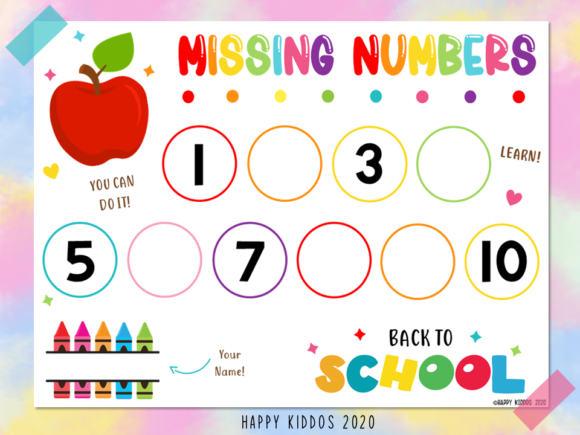
At its core, Number Missing Numbers Back to School is a digital product containing ten printable pages. Each page presents sequences of numbers from 1 to 20 with certain numbers omitted. The child fills in the missing numbers, reinforcing their understanding of numerical order and the relationships between numbers.
Because it arrives as a PDF file in a single zip folder, the resource is immediately accessible for home or classroom use. No physical product is shipped, which means educators and parents can print only what they need, when they need it. This flexibility is especially valuable for those who plan lessons in advance or need to adapt materials on the fly.
The simplicity of the format should not be underestimated. Missing-number exercises target a specific cognitive skill: recognizing patterns within a sequence and recalling which number comes before or after a given numeral. This foundational ability supports later work in addition, subtraction, and number sense.
Why This Resource Deserves Strategic Consideration
Many early math resources focus on counting from one to twenty in order. While that is necessary, Number Missing Numbers Back to School shifts the focus from rote recitation to active recall and pattern recognition. The learner must think about what is absent from the sequence rather than simply repeating what they have memorized.
From a planning perspective, this resource can serve multiple purposes. For a kindergarten teacher mapping out the first month of school, these pages can function as a diagnostic tool. Observing which numbers a child misses or hesitates on provides immediate insight into where that child needs additional support. For a parent working with a preschooler at home, the same pages offer a structured but low-pressure way to build familiarity with numbers before formal schooling begins.
Content creators and bloggers who develop educational materials can also benefit from understanding what makes resources like this effective. The missing-number format is widely recognized as developmentally appropriate for children aged four to six. When creating or recommending materials for this age group, focusing on activities that require active thinking rather than passive recognition aligns with best practices in early childhood education.
Using Number Missing Numbers Back to School to Support Learning Goals
Intentional use of Number Missing Numbers Back to School begins with clear goals. Are you trying to assess a child's current number knowledge? Are you introducing the concept of numerical order for the first time? Or are you providing practice for a child who already knows their numbers but needs to strengthen speed and accuracy?
Each goal suggests a different approach. For assessment, use one or two pages in a quiet setting and note which numbers the child fills in correctly and which they skip. Do not correct errors during the exercise; instead, review the results afterward to identify patterns. If a child consistently misses numbers in the teens, that tells you where to focus future instruction.
For initial instruction, consider using the pages alongside manipulatives such as number cards or counting objects. Before asking the child to write the missing number, point to the sequence and say the numbers aloud together. Then cover one number and ask the child to name it. This bridges the gap between oral counting and written representation.
For fluency practice, set a gentle timer or use the pages as a warm-up activity at the start of a math lesson. Children who already know their numbers will benefit from the repetition and the sense of accomplishment that comes from completing a page independently.
Practical Examples of How to Approach the Activities
Consider a typical page from Number Missing Numbers Back to School. It might show the sequence 1, 2, _, 4, 5, _, 7, 8, _, 10. A child who has never encountered missing-number problems may need explicit instruction on what the blank means. Demonstrate by saying, “I see the numbers 1, 2, then a blank, then 4. The number 3 is missing. Let’s write 3 in the blank.”
For pages that include higher numbers up to 20, the same approach applies, but you can add a layer of reasoning. Ask the child, “What number comes after 14?” or “What number comes before 19?” These questions encourage the child to think about the number line in both directions, which strengthens their mental model of number relationships.
Another practical strategy is to pair the worksheet with a number line posted on the wall or drawn on a whiteboard. The child can reference the number line to check their answers. Over time, reduce the reliance on the visual aid as the child internalizes the sequences.
For children who finish quickly, extend the activity by asking them to create their own missing-number puzzles for you to solve. This reversal of roles deepens their understanding and adds an element of play.
When to Use This Resource and When to Set It Aside
Number Missing Numbers Back to School is most useful during the first few months of the school year or when a child is first being introduced to numbers beyond their current comfort zone. Because the focus is on numbers 1 through 20, it works well as a bridge between early counting and more complex math concepts like comparing quantities or simple addition.
However, no single resource should dominate a child’s math experience. Use these pages as one component of a varied approach that includes hands-on activities, board games, songs, and real-world counting opportunities. If a child shows signs of boredom or frustration, set the pages aside for a few weeks and return to them later. The goal is not to complete all ten pages in one sitting but to build competence gradually.
For educators planning a math curriculum, consider using one page per day during the first two weeks of school. This creates a predictable routine while allowing you to monitor each child’s progress. After that, you can reintroduce the pages periodically as review or as part of a math center rotation.
Risks of Using Number Missing Numbers Back to School Without Clear Intentions
Any educational resource can lose its value when used without thoughtful planning. If a child is handed a page and told to fill in the blanks without any explanation or support, they may guess randomly or become frustrated. The exercise then becomes a source of stress rather than a tool for learning.
Another risk is overusing worksheets at the expense of kinesthetic and verbal learning. Young children need to touch, move, and talk about numbers, not just write them. Relying solely on Number Missing Numbers Back to School for number practice could lead to a narrow experience that does not fully develop number sense.
Additionally, if the resource is used primarily as busywork rather than as a targeted learning activity, children may learn to complete the pages mechanically without truly understanding the underlying concepts. The missing number becomes a puzzle to solve through guesswork rather than a question that requires reasoning.
To mitigate these risks, always pair the printable with conversation. Ask the child to explain their thinking. If they write the wrong number, ask, “How did you decide that number?” Their answer will reveal whether they misunderstood the task or simply made a careless error.
Decision-Making Guidance for Educators and Parents
When deciding whether Number Missing Numbers Back to School is right for your situation, start by asking yourself what specific gap you are trying to address. If a child can count from 1 to 20 but cannot identify a missing number in a written sequence, this resource directly targets that gap. If the child cannot yet recite the numbers in order, begin with oral counting and physical activities before moving to written worksheets.
For content creators and bloggers, this resource exemplifies a type of printable that remains in demand year after year. Parents and teachers consistently seek out materials that are simple, focused, and aligned with early learning standards. When creating your own resources or reviewing products for your audience, emphasize the specific skill being practiced and suggest multiple ways to use the material rather than presenting it as a one-size-fits-all solution.
For entrepreneurs and small business owners who sell educational printables, understanding the strategic positioning of products like this can improve your product descriptions and marketing. Highlight the cognitive skill, the age range, and the flexibility of the format. Explain how the resource can be used for assessment, instruction, or review. This level of detail helps buyers make informed decisions and reduces the likelihood of dissatisfaction.
Long-Term Value and Integration into Broader Learning Plans
The true value of Number Missing Numbers Back to School extends beyond the ten pages themselves. When used thoughtfully, these exercises help children develop a habit of checking their own thinking. They learn to look at a sequence, identify what is missing, and verify their answer by saying the sequence aloud. This metacognitive skill—thinking about one’s own thinking—is valuable across all academic subjects.
Furthermore, success with missing-number activities builds confidence. A child who completes a page correctly feels a sense of mastery that motivates them to tackle slightly harder tasks. Over time, this positive cycle supports a growth mindset toward mathematics.
To integrate this resource into a broader learning plan, consider the following approach. Use the first page as a baseline assessment. Then, over the next week, incorporate number games, counting songs, and hands-on activities that reinforce the same numbers. At the end of the week, use a second page to see if the child’s performance has improved. Repeat this cycle across the remaining pages, spreading them out over several weeks or months.
For parents who homeschool, these pages can be part of a morning binder that also includes letter recognition, simple handwriting, and a daily calendar activity. The consistency of a morning routine helps children transition into a learning mindset and provides a gentle start to the day.
What to Look for When Choosing or Creating Similar Resources
Not all missing-number worksheets are created equal. When evaluating resources like Number Missing Numbers Back to School, consider the following criteria. The numbers should be large and clearly printed, with enough space for a child to write comfortably. The sequences should be varied so that the child practices a range of missing positions, not just the same pattern each time. The design should be visually clean without distracting graphics.
The digital format offers additional advantages. You can print multiple copies for different children or reuse a single copy by placing it in a sheet protector and using dry-erase markers. This makes the resource economical and environmentally friendly.
If you are a creator developing your own missing-number printables, apply these same principles. Test your pages with a few children in your target age range to ensure the instructions are clear and the difficulty level is appropriate. Solicit feedback from educators who work with early learners daily.
Final Thoughts on Using This Resource Intentionally
Number Missing Numbers Back to School is a straightforward tool, but its effectiveness depends entirely on how it is used. When you approach it with clear goals, appropriate context, and a willingness to adapt, it can support meaningful learning. When used randomly or without explanation, it becomes just another worksheet.
The most important takeaway is that early math learning happens best when children are actively engaged, thinking, and talking about what they are doing. Missing-number exercises fit naturally into this approach because they require active recall and reasoning. By pairing the printable with conversation, hands-on activities, and thoughtful pacing, you give the child the best chance to build a solid mathematical foundation.
Whether you are an educator planning your first weeks of school, a parent supporting your child at home, or a content creator developing materials for others, the principles remain the same. Know your goal, adapt your approach, and always prioritize understanding over speed. That is how a simple set of ten pages becomes a genuinely useful part of a child’s learning journey.